Because in academia, your name and your body of work is a big deal that can open or close doors, and assigning credit is an important part of it. This isn't a new thing/exclusive to the AI era either.
I haven't played it myself, but surely an article written one month after the game's release doesn't do it justice, considering there have been multiple major updates attempting to address the gripes players initially had with the game in the 10 years since then (And review trends on steam indicate that these attempts were successful)
They've added a lot of elements inspired by other games. One of the first things they added was base-building. Also a colony sim subgame, a pokemon-like subgame, fishing and cooking subgames, a roguelike subgame (exploring derelict dreadnought spaceships), as well as a lot more non-procedurally generated storyline/quests.
The worst thing I can say about it is that it tries to be everything for everyone, and is relentlessly friendly - all the new mechanics are very forgiving, very optional and (from what I've seen) rather easy. But there is sort of an in game story explanation for why it sometimes feels more like Stardew valley than a space exploration game.
The original massive controversy was the founder of the studio claiming it had multiplayer when it very clearly didn't which was such an odd thing to claim and easy to prove false.
That and the trailer was very different than the released game.
They apologized IIRC and then continued to work on it for like a decade - adding multiplayer and many large changes to the game
Unfortunately, given the sheer magnitude of text on the internet, we need heuristics to gauge whether something is worth reading or not.
For authors/blogs that I don't yet know, LLM-generated text is a clear anti-signal for me, and Pangram has been very useful in that regard.
False positives (Pangram labels something slop that isn't) I'm not that worried about, since the worthwile articles generally circle back to me some way through the communities I'm involved in, so I like to err on the side of not instantly reading something anyways.
For false negatives, that depends on the type of article at hand. If an error leads to me spending 2 minutes reading an article that ended up being not worth reading I'd be fine with an order of magnitude more than if false positives happen on articles that take 30 minutes to go through. Maybe on the order of 1-3% overall?
In a rug pull, the thing you own (usually some kind of digital asset) goes down in value, leaving you with less money than you started with, whereas theft leaves you no longer possessing the asset itself.
A few extra steps. Usually, the rug pull doesn't involve directly taking something that belongs to other people, but instead, selling your own thing in a dishonest way.
> Are there any regular typing keyboards with velocity sensitive keys? I genuinely don't know
Yes, a number of the mechanical keyboards that use Hall effect switches let you access the velocity data. Wooting has an official SDK, and there are community-supported drivers for a number of Keychron boards
Yeah, velocity definitely jumped out at me as a difference, but it seems(?) like being velocity-sensitive could 2x the cost, maybe even 3x, but not 10x ¯\_(ツ)_/¯
I'm absolutely not calling it over-priced, just puzzled.
Well the only moving part in a typing keyboards is a mass-produced switch that you slot into a PCB. There are mass-produced hall effect switches that can provide velocity sensitivity, but it's a pretty distant comparison. The keys on a lumatone aren't anything like buttons; they're weighted mechanical arms with significant travel -- much more like a piano key than a keyboard key. And it has 280 of these! The degree of mechanical hardware in this thing makes it seem not really comparable to a PCB with some switches slotted into it.
That said! There are people making DIY isomorphic keyboards using hall-effect keyboard switches. None are commercially available right now, but see e.g. the MidiHex at https://gullsonix.co.uk/. You could make one for a fraction of the cost of a lumatone -- but of course it would be a very different instrument.
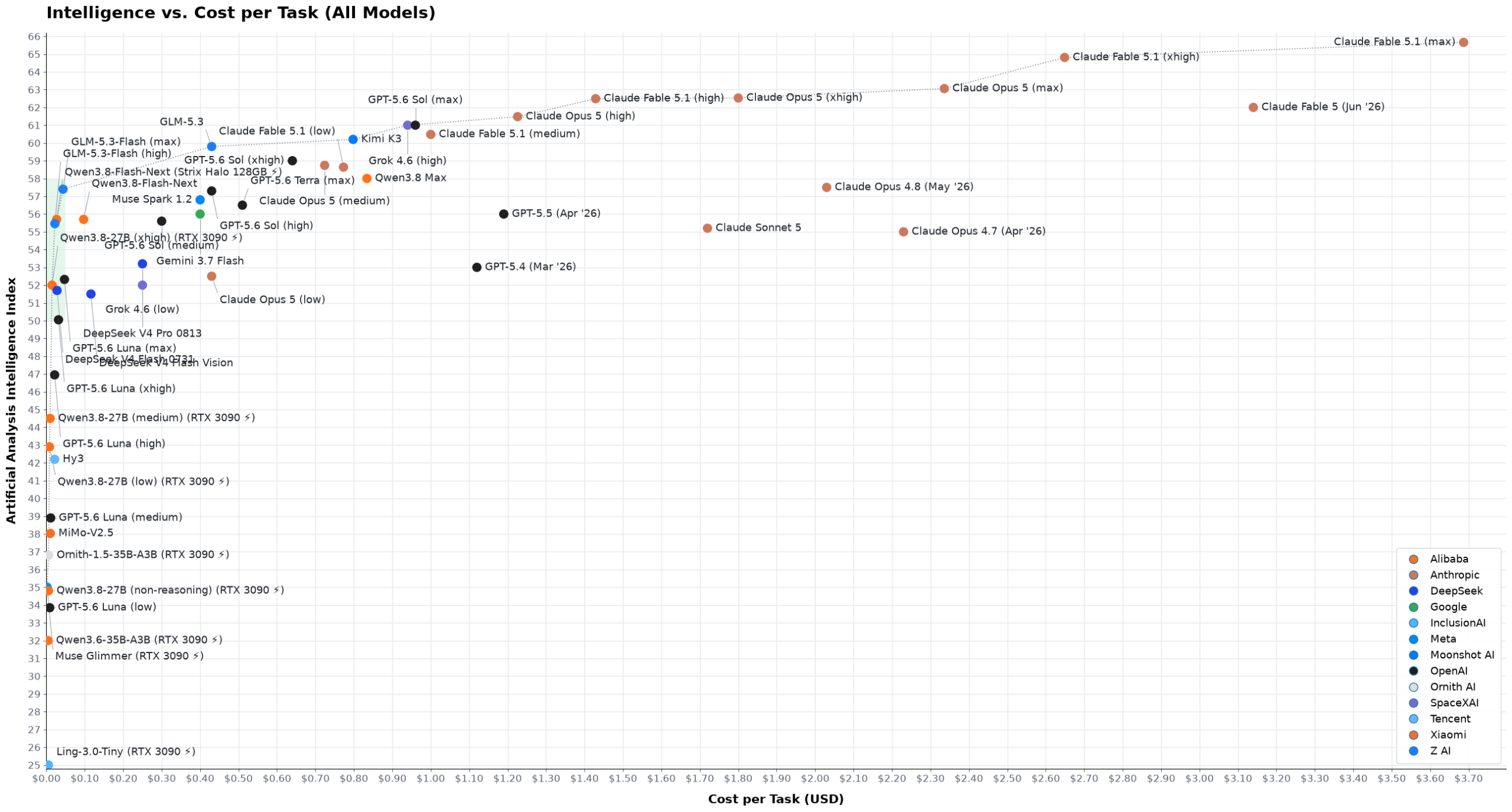
> The first issue I have with it is that it uses a logarithmic scale on the cost axis. Using a log scale is the only way to make you spot the difference between a model that costs $0.015 per task and one that costs $0.032, while the same plot contains a model that costs $3.69 — almost 250 times as expensive. However, the net result is that the viewers can no longer appreciate the immensity of the price difference between the cheap models and the heavy ones; nor can they realize how inconsequential the price differences are between the cheap models.
This is an asinine complaint, and nobody can seriously tell me that the last plot on their page [0] is more readable than the AA one [1]. If I'm using a model at the lower range of the cost scale for whatever list of tasks, and i switch to another model at the lower end of the cost scale, my spending might double anyways! This should be reflected in the plot, and linear scale doesn't do it justice.
It's also much easier to see the mentioned pareto frontier in the log plot than in the linear one.
I can see why they disagree with the pricing determination for open/local models, but I don't think there is one clear right way to do it. So how do they do it instead?
>Hardware is priced at zero, on the basis that both an RTX 3090 PC and a 64GB Strix Halo are desirable gaming/work machines anyways.
...oh
Would have been nice to mention explicitly how the pareto frontier changes with those new calculations.
It’s funny they state log plot is “the only way” to keep the cheap area readable, say they hate it, and then immediately have to zoom into their non-log plot cheap area because it’s unreadable.
> This course teaches the craft of building practical quantum circuits from scratch.
Can't wait to have an ion trap in my living room!
I would love to appreciate the work that is going into this curriculum, but when the lesson overview is overwhelming amounts of AI copy slop I just can't bring myself to be interested.
Edit: i'm talking about the text, not the pictures. It's not overwhelming in the sense that it is a lot of text, but in the sense that the amount of Claude-isms in relation to both word count and actual content is way too high for me to care about. Take lesson 9 for example:
9. Where the quantum lives
    every page is a classical drawing

    the animation is impossible

    each step has a classical model; they refuse to glue

    one story per step, no story overall

    where the quantum actually lives

    and the gap has a price, in coherent memory
I have no idea what is going on here or what the topic of this lesson is, and the same is true for like half of the lesson overviews here.
Like i said, i'd love to be able to judge the content, but there is none here.
In one minute, I learned they commissioned the art from an actual artist. Calling a few bullet points under each image "overwhelming" is strange. Perhaps get over yourself.


reply